Abstract
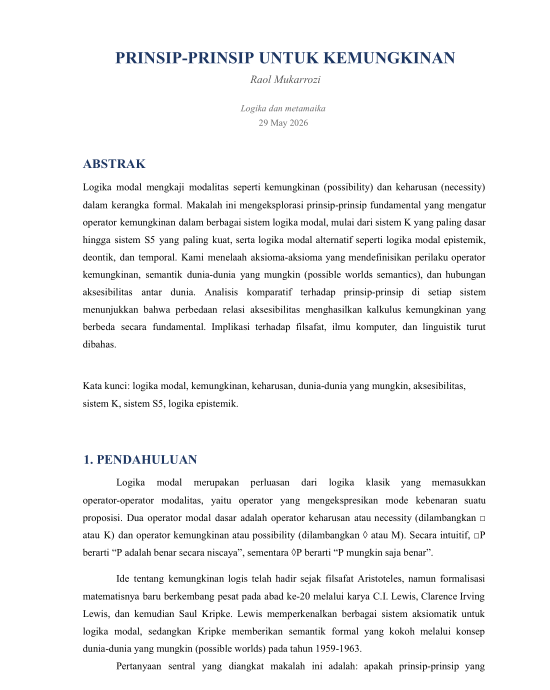
Modal logic studies modalities such as possibility and necessity within a formal framework. This paper explores the fundamental principles governing possibility operators in various modal logic systems, ranging from the basic K system to the stronger S5 system, as well as alternative modal logics such as epistemic, deontic, and temporal logic. We examine the axioms that define the behavior of possibility operators, possible worlds semantics, and accessibility relations between worlds. A comparative analysis of the principles within each system demonstrates that differences in accessibility relations produce fundamentally different calculi of possibility. The implications for philosophy, computer science, and linguistics are also discussed.
Keywords
Modal logic
Epistemic logic
Possible worlds semantics
References
- Blackburn, P., de Rijke, M., & Venema, Y. (2001). Modal Logic. Cambridge University Press.
- Chellas, B. F. (1980). Modal Logic: An Introduction. Cambridge University Press.
- Fagin, R., Halpern, J. Y., Moses, Y., & Vardi, M. Y. (1995). Reasoning About Knowledge. MIT Press.
- Kripke, S. A. (1963). Semantical considerations on modal logic. Acta Philosophica Fennica, 16, 83–94.
- Kripke, S. A. (1980). Naming and Necessity. Harvard University Press.
- Lewis, C. I., & Langford, C. H. (1932). Symbolic Logic. Dover Publications.
- Lewis, D. (1986). On the Plurality of Worlds. Blackwell.
- Segerberg, K. (1971). An Essay in Classical Modal Logic. Uppsala University.
- Zeman, J. J. (1973). Modal Logic: The Lewis-Modal Systems. Clarendon Press.